
Wild Horse Photography: The Relationships Within the Herd
Sep 22, 2026
By Artistic Creationz Photography · Photographs by Neal Nachman and Liz Stokes
A wild horse has an unmistakable presence. The shape of its mane, the pattern of its coat and the direction of its gaze can hold our attention long before we notice anything else in the photograph. Spend more time looking, and another question emerges: what is happening beyond the edge of the frame?
Wild horse photography can open a window into a social world. Horses share space, form associations and respond to one another. Looking for those relationships changes how we understand an individual portrait and what we watch for when several horses appear together.
Three photographs from our Wild Horse Photography collection offer a starting point. Made in Corolla, North Carolina, and Nevada, these portraits introduce individual horses in different settings. Each invites a closer look at the animal before we consider the larger life of a herd.
Begin with the individual
It is easy to describe a group simply as “the horses.” Photography encourages a more attentive approach. A white marking on a face, an uneven patch of color or the fall of a mane gives the eye something specific to remember.
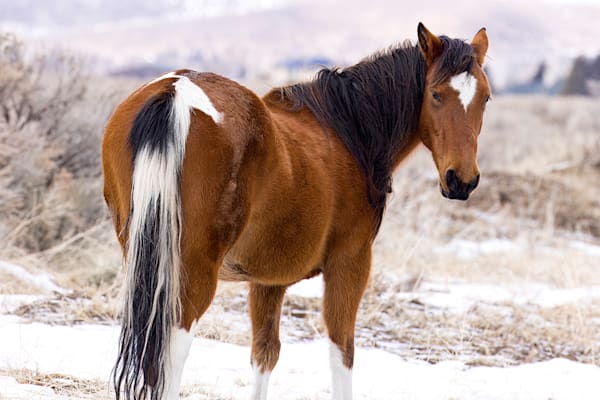
In Painted Horse, the brown-and-white coat is central to the portrait. The horse’s body faces away while its head turns back, allowing us to see both its markings and its face. The photograph holds our attention through those particular details.
Recognizing individuals is also a useful first step toward understanding a group. When you can distinguish one horse from another, you can begin to notice who repeatedly stands nearby, who follows whom and whether an apparent pairing lasts beyond a single moment. A photograph provides one observation; a sequence provides context.
A herd contains smaller social groups
The word “herd” can suggest one large, undifferentiated gathering. Within wild horse populations, smaller social bands are an important part of daily life. The National Park Service’s account of the Shackleford Banks horses, for example, describes groups of mares and young with a stallion, as well as bachelor bands.
That background gives a photographer useful questions to ask. Which horses remain together as the group moves? Does a younger animal keep returning to the same adult? Do two horses settle beside one another after grazing apart? These are things to observe over time, without assuming that a brief view reveals the whole relationship.
The Shackleford example describes that population; it does not identify the family connections or social roles of the horses pictured here. A portrait alone cannot establish those details.
One horse in the frame is one part of the scene
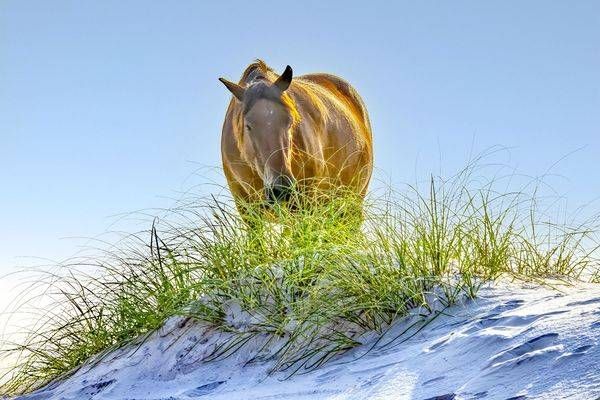
Day Dreamin’ gives its subject room within the dunes. Pale sand, grass and open sky surround the horse, making the setting part of the portrait. There is a sense of space around the animal, even though the photograph shows only a small piece of its environment.
That distinction matters when we look at wild horse images. A horse appearing alone in a composition is not necessarily living alone. Other animals may be outside the frame. The photographer’s crop determines what the viewer sees, so an individual portrait and a wider view of a band answer different questions.
Look for the small exchanges
Relationships can become visible in everyday interactions. The National Park Service’s wild horse behavior guide describes mutual grooming among familiar horses, including mares and their older offspring. Such exchanges offer a specific behavior to watch for when observing a band.
For a photographic sequence, the moment before and after an interaction can be as revealing as the interaction itself. One frame may show an approach, another a shared pause, and a third the horses moving apart. Together, they let the viewer follow what happened.
When two horses are in a photograph, look at the space between them and the direction of their bodies. Both animals need to contribute to the story. A second horse partly cut off at the edge may remove the very connection that made the moment interesting.
Read a gesture in context
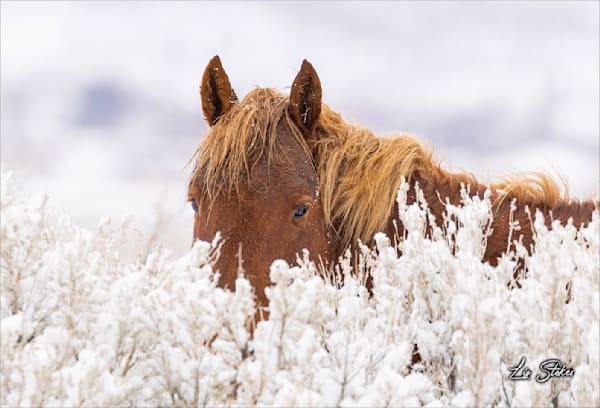
In Peekin’ Horse, the brush conceals much of the animal, drawing attention to the visible face, ears and mane. That partial view makes the portrait engaging. It also reminds us how much information a single photograph leaves out.
A turned head or a change in posture can suggest a question without supplying an answer. Before describing a horse as protective, dominant or affectionate, consider what was actually observed. The same care applies to captions: identify the location and visible action when known, and leave unconfirmed family relationships open.
Giving horses room is part of observing those interactions. Use a long lens, follow the viewing guidance for the place you visit, and avoid stepping between animals or blocking their movement. Our journal article on photographing wildlife in Tampa Bay explores the broader importance of allowing natural behavior to unfold.
Discover the individuals within the herd
The more closely we look, the more individual a wild horse becomes. A distinctive coat, a face emerging from winter brush or a quiet stance among coastal dunes gives us a particular animal to remember. From there, we can begin to appreciate the relationships that extend beyond the portrait.
Explore the complete Wild Horse Photography gallery to see more work by Neal Nachman and Liz Stokes. Select any featured photograph above to view its artwork page, or contact Artistic Creationz with a question about a piece.