

Sunrise vs. Sunset Photography: Choosing the Best Light for the Landscape
Sep 29, 2026
By Neal Nachman and Liz Stokes, Artistic Creationz Photography
When we arrive at a landscape, the most useful question is rarely, “Is sunrise better than sunset?” We ask where the light will come from, what it will touch, and what we want the photograph to feel like. The same beach can look hushed and spacious before dawn, then turn graphic and fiery at dusk. Neither version is automatically the stronger photograph.
Our work takes us from Florida’s coast and Tampa Bay to mountain and lake country. Those places have taught us that sunrise vs. sunset photography is a decision about the scene, not a rule about the clock. A compelling sky helps, but a clear subject, a thoughtful viewpoint, and the right light on that subject matter more.
Start with the direction of the light
The sun rises broadly in the east and sets broadly in the west, with its exact position changing through the year. That sounds simple until a headland, building, line of trees, or mountain ridge enters the frame. We look at where the sun will sit relative to our subject, not just whether the forecast promises color.
Side light can rake across rocks, sand, driftwood, or a mountain face and make texture visible. Light from behind the camera may show color and detail clearly, but it can make a flat subject feel flatter. Backlight can turn a bridge, tree, or palm into a silhouette, or lay a bright path across water. These choices apply at either end of the day. In our guide to golden hour landscape photography, we look more closely at how the angle of low light changes a composition.
What sunrise gives a landscape
We love the quiet before the day gathers momentum. On some mornings the air is clearer, the shoreline is less busy, and water is still enough to hold a reflection. On others, mist or marine haze softens distant forms. None of that is guaranteed, but it gives sunrise photography a set of possibilities worth getting out early for.
Liz’s Early Light shows why we are willing to arrive before the sun. At Juno Beach Pier, the lines of the structure give the eye a way into the Atlantic scene while the first color remains gentle. The photograph is not asking a blazing sun to do all the work; the pier and the open water carry the frame.

Blue hour before the sun appears
Blue hour photography can begin while the sun is still below the horizon. The sky may already have shape and color, but the contrast is gentler than it will be once direct light arrives. We use those minutes to find the relationship between foreground and horizon, settle the camera, and watch for a moment when a cloud edge or patch of water comes alive. A shoreline facing east can be beautiful even when the sun itself never enters the picture.
What sunset gives a landscape
Evening lets us study a place in daylight, refine a composition, and then watch it change. Low sun can warm the side of a tree or rock, while clouds may hold color after the sun has gone below the horizon. A little haze can make distant layers softer and warmer; too much can erase the detail we hoped to show. The weather decides which version we get.
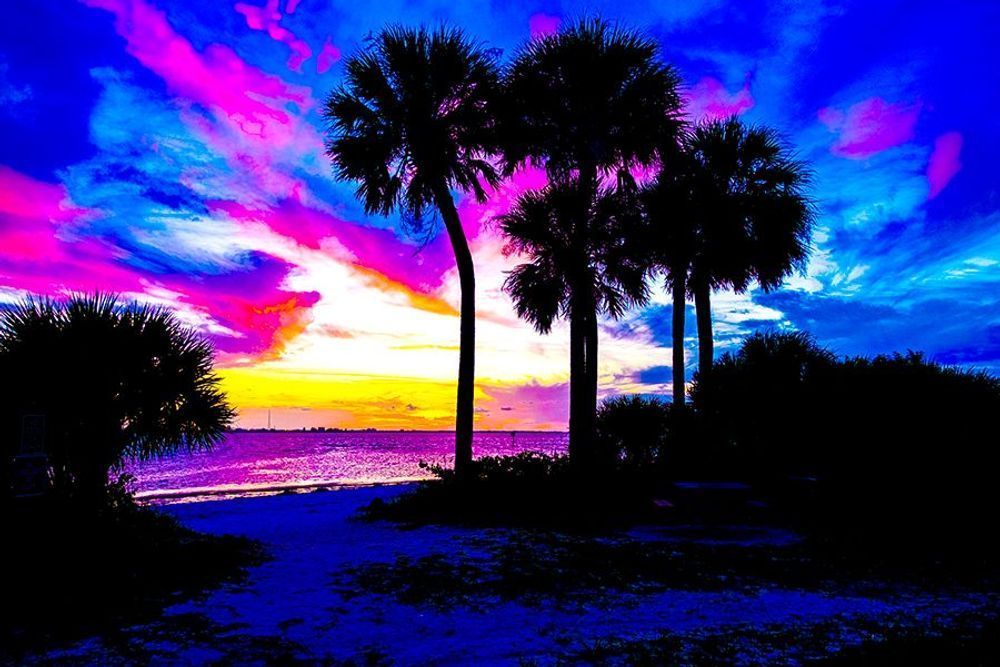
In Liz’s Electric Sunset, palm silhouettes anchor a tropical shoreline beneath intense color. We are drawn to the tension between those dark, recognizable shapes and the luminous sky. The photograph reminds us that a dramatic sunset still needs an arrangement of forms; color alone is not a composition.
Stay for the light after sunset
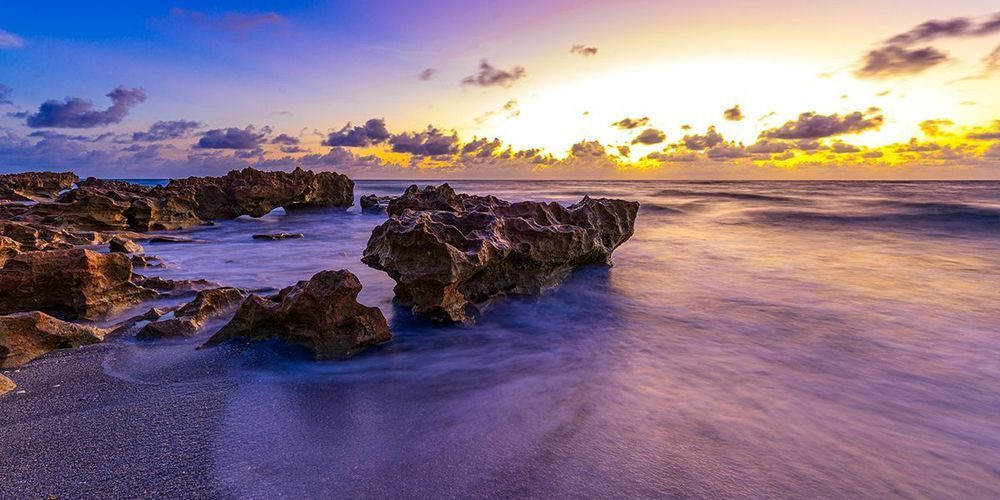
We do not put the camera away when the sun disappears. The sky can cool toward blue while a band of warm color lingers near the horizon. Water and wet rocks may retain enough reflected light to separate from the darker shore. Neal’s Twilight Hour uses a rocky coast, moving water, and a wide glowing sky to hold that transition. It is a good reminder that the most interesting frame may come after the expected “sunset shot.”
Let the location make part of the decision
On an Atlantic-facing Florida beach, a clear view east often favors dawn. Along parts of the Gulf Coast, an open western horizon makes sunset a natural starting point. But even those familiar patterns have exceptions. A dune, pier, tree, or curve of shoreline can look better with the sun behind us or off to one side. We would rather move our feet and study the subject than insist on the obvious horizon.
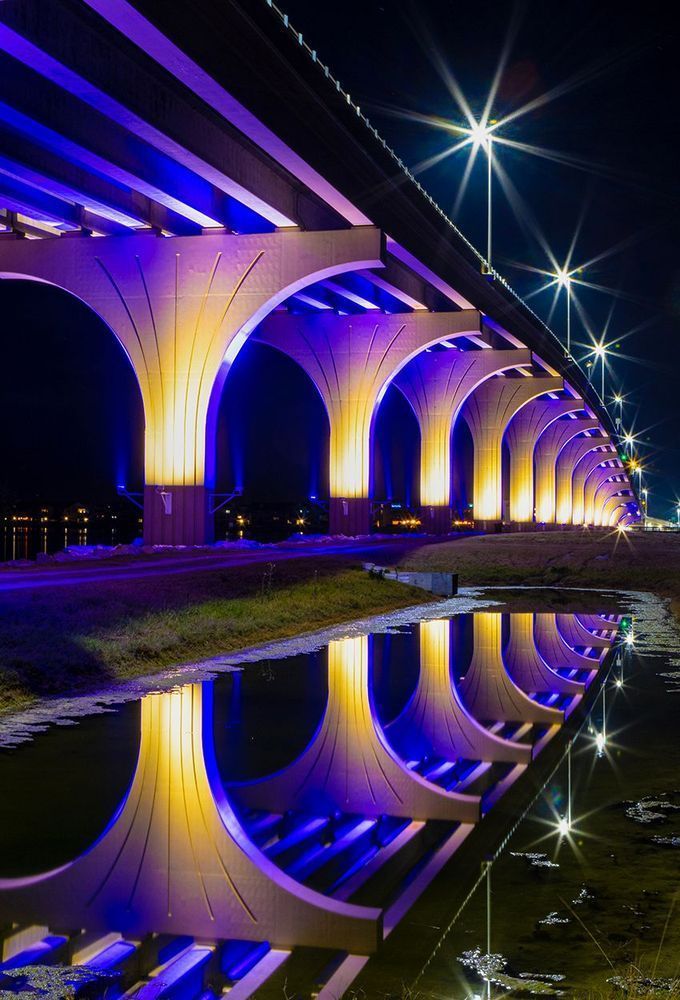
Water adds another variable. At a lake, bay, or tidal flat, the best reflection depends on wind, surface texture, and the viewing angle as much as on sunrise or sunset. Neal’s Bridge of Reflection uses the Tierra Verde Bridge and its mirror image to make a near-symmetrical composition. The lesson is the shape the water gives back, rather than a claim that one time of day always provides calm.
Mountains ask for the same attention to direction, with the added complication of terrain. A ridge can block direct light from the valley long before the official sunset, while a high peak may catch warm color for a few more minutes. A beach asks us to watch tides and wet-sand reflections; a mountain lake asks us to watch wind and which slopes are lit. The “best light for landscape photography” changes with the land in front of us.
Why we scout before choosing sunrise or sunset
If we can visit a location ahead of time, we look for an actual composition first: a shoreline curve, a leading line, an opening between trees, a foreground that earns its place. Then we consider where the sun will rise or set on that date, what may block it, how clouds could be lit, and whether we can safely reach the viewpoint in the dark. We also check access and, on the coast, the tide. A beautiful sky is of little use if the foreground we planned for is underwater or the viewpoint is unavailable.
Scouting is also a way to leave room for surprise. At Boneyard Beach, the sculptural driftwood in Neal’s Golden Driftwood becomes the subject because low, warm light reveals its texture and separates it from the shoreline. That is a stronger reason to choose a time than a generic promise of “golden hour.” The direction of the light has to serve the wood.

How we choose in the field
Our decision usually follows a short sequence. First, where is the strongest subject? Next, from which position will the light describe it best? Then we look at cloud cover, haze, wind, water, and the mood we want. A blue, quiet photograph may be the right answer for one scene; a warm silhouette may be right for another. If the weather does not support the idea we came with, we change the idea.
That is true close to home, too. In our Tampa Bay landscape photography story, a sunrise aligned with the Sunshine Skyway becomes a precise meeting of sun and bridge, while another image is shaped by a reflection. The two photographs call for different judgments, even though both belong to the same area. As Tampa landscape photographers, we have learned to look for the relationship among place, light, and composition rather than chase a color on a forecast.
Our Florida landscape workshops and developing Lake Tahoe photography tour are built around that kind of field judgment. A schedule can put us in a promising place, but it cannot promise the sky. We work with the conditions that arrive.
There is no universal winner
Sunrise may offer still water, a quiet beach, or the first light on a pier. Sunset may give us time to refine a frame, glowing clouds, or a long transition into blue hour. Sometimes neither delivers what we expected, and the best photograph comes from a side-lit detail or a change of viewpoint. The most useful landscape photography tip we can offer is to decide what the scene needs before deciding which hour should win.
To see how we interpret these moments as fine art, explore our landscape and architecture collection, sunrise and sunset photographs, and the broader fine art photography galleries. The Collector Gallery shows how finished work lives in real spaces, and select light-rich landscapes can be explored as illuminated fine art.
Follow the Photography Journal for more stories from behind our cameras, or explore the Photography Tours we are developing. If a photograph speaks to you, or you would like to talk about artwork or a photography experience, contact us. We would be glad to help you find the light and the landscape that feel right for you.